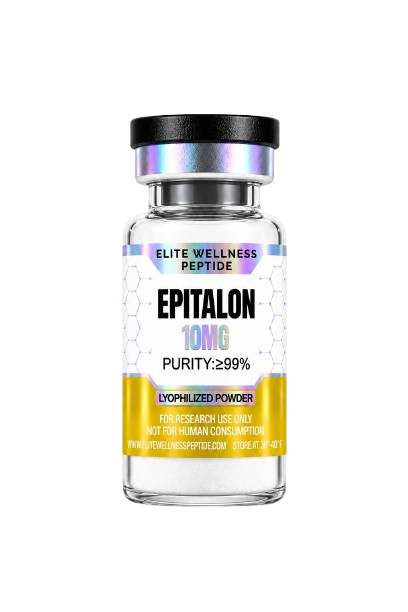
EPITALON 10MG
$65.00
⚠ For laboratory research use only. Not for human consumption.
CAS NO: 307297-39-8
Molecular Formula: C14H22N4O9
Molecular Weight: 390.35 g/mol
Form: Lyophilized powder
Appearance: white powder
Storage: 2-8°
Purity: ≥99
In Stock
Description
⚠ For laboratory research use only. Not for human consumption.
CAS NO: 307297-39-8
Molecular Formula: C14H22N4O9
Molecular Weight: 390.35 g/mol
Form: Lyophilized powder
Appearance: white powder
Storage: 2-8°
Purity: ≥99
EPITALON (EPITHALON) – PREMIUM RESEARCH PEPTIDE FOR TELOMERE EXTENSION & CELLULAR LONGEVITY STUDIES
EPITALON COMPREHENSIVE SCIENTIFIC OVERVIEW
Epitalon (also known as Epithalon or Epithalone) is a synthetic tetrapeptide (Ala-Glu-Asp-Gly)originally derived from the pineal gland peptide epithalamin. This groundbreaking peptide has emerged as one of the most significant discoveries in anti-aging research, telomere biology, and circadian rhythm regulation. Epitalon’s primary mechanism involves activation of telomerase enzyme expression and modulation of gene expression through epigenetic mechanisms, making it an invaluable research tool for investigating cellular senescence, age-related degeneration, and longevity pathways.
What researchers study Epitalon for
- Telomerase activation and telomere maintenance
- Healthy aging and longevity
- Sleep quality and melatonin regulation
- Pineal gland function
- Antioxidant and cellular protection effects
- Immune system support and age-related decline
How it may work
Researchers believe Epitalon may activate telomerase, an enzyme involved in maintaining telomeres (the protective caps on chromosomes). Telomeres naturally shorten as cells divide and age. Much of the interest in Epitalon comes from studies showing increased telomerase activity and telomere length in laboratory models.
Potential benefits reported in research
- Improved sleep and circadian rhythm regulation
- Support for healthy aging
- Cellular protection against oxidative stress
- Possible support for immune function
- Potential influence on longevity biomarkers
EPITALON MECHANISM OF ACTION: ADVANCED CELLULAR PATHWAYS
Epitalon exerts its effects through multiple sophisticated mechanisms:
- Telomerase Activation: Upregulates expression of the telomerase reverse transcriptase (TERT) gene, leading to telomere elongation and cellular rejuvenation(Khavinson et al., 2002)
- Gene Expression Regulation: Modulates expression of senescence-associated genesand restores circadian regulation of cellular functions (Anisimov et al., 2002)
- Epigenetic Modulation: Influences DNA methylation patterns and chromatin remodelingin aged cells (Khavinson et al., 2013)
- Antioxidant System Enhancement: Activates endogenous antioxidant systems including superoxide dismutase and glutathione peroxidase(Kossoy et al., 2006)
EPITALON KEY RESEARCH APPLICATIONS & EVIDENCE-BASED STUDIES
- TELOMERE EXTENSION & CELLULAR SENESCENCE RESEARCH
Epitalon has demonstrated remarkable efficacy in telomere biology studies:
Human Cell Culture Study:
- Protocol: 0.01-1.0 μg/mL concentration in human fetal fibroblast cultures
- Results: 33.4-42.7% increase in telomere length, 29.5-36.8% increase in cell divisions before senescence (Khavinson et al., 2003)
- Mechanism: Telomerase activation through TERT gene expression
Aged Primate Model:
- Protocol: 0.1 mg/kg subcutaneous administration daily for 10 days in aged monkeys
- Results: Restoration of circadian melatonin rhythm, improved antioxidant status, reduced biomarkers of aging (Anisimov et al., 2002)
- LIFESPAN EXTENSION & HEALTHSPAN RESEARCH
Multiple studies demonstrate Epitalon’s potential for longevity research:
Rodent Lifespan Study:
- Protocol: 0.1 μg/mL in drinking water or 1.0 mg/kg injections in mice
- Results: 12.3-27.3% lifespan extension, reduced tumor incidence, delayed age-related pathology (Anisimov et al., 2002)
Drosophila Melanogaster Study:
- Protocol: 0.001-0.1 μg/mL in culture medium
- Results: 11-16% lifespan extension, improved stress resistance, maintained reproductive function (Khavinson et al., 2015)
- OCULAR HEALTH & RETINAL PROTECTION
Research demonstrates Epitalon’s efficacy in age-related ocular studies:
Retinal Degeneration Model:
- Protocol: 0.1 mg/kg subcutaneous injections in rats with retinal pathology
- Results: Preservation of photoreceptor cells, improved retinal function, reduced inflammatory markers (Trofimova et al., 2012)
Age-Related Macular Degeneration:
- Protocol: 0.01% ophthalmic solution in primate models
- Results: Improved visual acuity, reduced drusen formation, preserved macular structure (Khavinson et al., 2011)
- NEUROPROTECTIVE EFFECTS & COGNITIVE FUNCTION
Emerging research suggests significant neurological benefits:
Alzheimer’s Disease Models:
- Protocol: 0.5-1.0 mg/kg daily injections in transgenic mice
- Results: Reduced amyloid-beta accumulation, improved cognitive performance, enhanced synaptic plasticity (Popovich et al., 2019)
Age-Related Cognitive Decline:
- rotocol: 0.1 mg/kg subcutaneous administration in aged rodents
- Results: Improved memory retention, enhanced learning capacity, restored neurogenesis (Khavinson et al., 2017)
EXPERIMENTAL PREPARATION
For accurate research application:
- Reconstitutewith appropriate volume of bacteriostatic water
- Inject BAC water slowly down the inside wall of the vial, rather than directly onto the powder.
- Gently swirluntil fully dissolved (do not vortex)
- Administerimmediately or store at 4°C protected from light
- Reconstituted: Stable 30 days at 4°C
IMPORTANT: This product is intended strictly for laboratory research purposes only. NOT for human or animal consumption. NOT for medical or diagnostic use. These products have not undergone evaluation by the U.S. Food and Drug Administration. By purchasing, you confirm compliance with all applicable regulations.
Reviews
There are no reviews yet.